


Guide
Electrolux Dryer Takes Too Long to Dry: A Step-by-Step Airflow Check
When an Electrolux dryer takes too long to dry, the cause is nearly always that damp air cannot leave the drum fast enough: a full lint filter, a restricted duct or hood, or an oversized load. Clean the filter, look at the visible duct and outside vent, and size the load before suspecting the heater. A dryer that still runs long with all of that clear needs diagnosis.
Electrolux Dryer Takes Too Long to Dry
Drying is an airflow process as much as a heating process. Even a working heater cannot dry efficiently if moist air cannot leave the drum, which is why Electrolux emphasizes the lint filter, exhaust duct, and exterior vent.
Start with the checks you can perform from outside the appliance. If the symptom is tied to water, heat, gas, electricity, or moving parts, stop when the condition becomes unsafe rather than repeatedly testing the appliance. The exact diagnostic path can vary by model, so keep the full model number available.
| Symptom | What it can point to | What you can check |
|---|---|---|
| Clothes damp and the dryer feels very hot outside | Restricted lint filter, duct or exterior hood | Clean the filter and check that the vent opens during a cycle |
| Damp air or moisture in the drum between loads | Exhaust damper stuck open or missing | Check the outdoor damper movement |
| Cycles run long only in humid weather | High humidity in the laundry area | Compare with drier days before suspecting a fault |
| Electric dryer slow after a move or new install | A 208 V supply, which dries more slowly than 240 V | Ask an electrician what the circuit provides |
| Everything clear and drying is still slow | Heater, sensor, blower or control problem | Stop and book diagnosis |
Start With the Lint Filter
One of the first possibilities is lint filter restriction. Clean the lint filter before the next load. This is useful because it rules out a condition that can imitate a component problem without requiring disassembly.
Inspect the Exhaust Duct
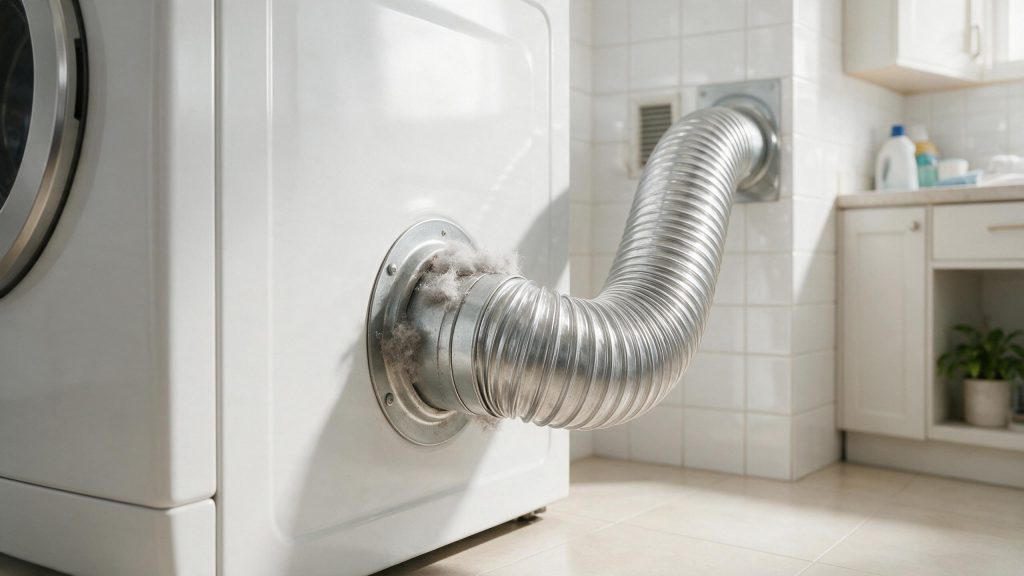
Next, consider clogged or crushed exhaust duct. Inspect the accessible exhaust duct for bends, crushing, or lint buildup. Look for a clear change in behavior rather than making several adjustments at the same time.
Duct Rules That Affect Drying Time
The use-and-care manual for Electrolux front-load dryers says the exhaust must be free-flowing, 4 inch rigid or semi-rigid metal duct vented outdoors, with no foil or plastic flexible venting and no screen over the outdoor opening. It allows no more than four 90-degree elbows, and semi-rigid duct must not exceed 8 ft.
Exceeding the allowed length or elbow count can cause lint to accumulate. That explains a dryer that worked for years and slowed after the machine was moved or the duct was rerouted. The manual also says the exhaust system should be inspected and cleaned at least every 18 months.
Check the Exterior Vent Hood
Another common branch is blocked exterior vent hood. Make sure the exterior vent damper opens when the dryer is running. If the symptom began immediately after installation, cleaning, a power event, or moving the appliance, that timing is especially useful.
Slow Drying Without a Component Fault
Not every long cycle is a repair. The manual lists high humidity and an electric dryer on a 208 V circuit as causes of long drying, with drying about 20 percent longer than on 240 V. Waxy build-up from fabric softener sheets can also coat the lint filter and the moisture-sensing bars; the manual says to wash them with warm soapy water and dry them thoroughly.
Load size matters as well. The manual says items need room to tumble, and an average wet load fills the drum one-third to one-half.
Review Load Size and Cycle Settings
Do not overlook overloaded dryer. Dry a reasonably sized load rather than packing the drum tightly. If that check is normal, the remaining causes move farther toward internal components or controls.
Common Questions
Why is the outside of my dryer hot but the clothes still damp?
The manual lists a clogged lint filter, restricted exhaust and duct that does not meet requirements as causes. Heat that cannot leave the drum with the moist air makes the dryer feel hot without drying faster.
Can fabric softener sheets slow drying?
They can leave a waxy film on the lint filter and the moisture-sensing bars. Washing both with warm soapy water, drying them completely, and putting them back is the manual’s fix.
Safe Troubleshooting Checklist
- Clean the lint filter before the next load.
- Inspect the accessible exhaust duct for bends, crushing, or lint buildup.
- Make sure the exterior vent damper opens when the dryer is running.
- Dry a reasonably sized load rather than packing the drum tightly.
- Choose a cycle and temperature appropriate for the fabrics.
- Lint filter restriction.
- Clogged or crushed exhaust duct.
- Blocked exterior vent hood.
- Overloaded dryer.
- Cycle or temperature not suited to the load.
- Heater, sensor, blower, or control issue.
- Electrolux Dryer Repair
- Electrolux Dryer Error Codes
- Electrolux Dryer Not Heating but Drum Turns: Power and Heating Checks
- Electrolux Dryer Won’t Start: Door, Start Control, and Power Checks
- Electrolux Dryer Not Heating: What Changes the Repair Cost?
- Electrolux Dryer Won’t Start: Door, Start Control, and Power Checks
- Electrolux Dryer Stops Mid-Cycle: Overheating and Electrical Stop Conditions
Common Causes to Keep in Mind
Use a Repeatable Troubleshooting Sequence
Change one condition at a time and record the result. Confirm the operating mode or setting, compare a related function that still works normally, perform one safe external check, and then reassess.
If the same symptom remains, do not keep adding resets or random parts. Record the complete model number and any displayed code before power is interrupted. That gives a technician a cleaner starting point.
When Long Dry Times Need Repair
Stop if the dryer becomes unusually hot, the vent has no airflow, or a gas dryer is not vented outdoors. If airflow is clear but drying remains unusually slow, schedule dryer repair. The heater, gas burner system, blower, moisture sensing, temperature sensing, or controls may need diagnosis. Clear notes about what changed, when the symptom appears, and what you already checked can make the service visit more efficient.
What to Tell the Technician
Provide the full model number, when the symptom started, whether it happens every cycle or only under certain conditions, and any display message or error code you have seen. Mention recent installation work, power outages, plumbing changes, filter changes, or unusual noises. Those details help separate a setup issue from a component or control problem.
FAQ
Can a blocked vent make drying take much longer?
Yes. Electrolux specifically calls out exhaust restrictions and the exterior vent hood.
How full should the dryer be?
Clothes need room to tumble. Very dense loads reduce airflow through the fabrics.
Why is venting especially important on a gas dryer?
Proper outdoor venting removes combustion products as well as moisture; do not operate a gas dryer without the required exhaust system.
Related Electrolux Repair Resources
Similar Articles
Keep reading
Similar articles
Electrolux Microwave Vent Fan Keeps Running: A Step-by-Step Heat and Control Check
A vent fan that keeps running on an Electrolux over-the-range microwave is often the microwave protecting itself from heat that rises off the cooktop…
Electrolux Washer Draining Slowly: A Step-by-Step Drain Check
A slow-draining Electrolux washer most often comes down to the path after the pump: a kinked drain hose, a standpipe that is too tall…
Electrolux Dishwasher Not Draining: A Step-by-Step Drain-Path Check
When water stays in the tub, work along the drain path: confirm the cycle actually finished, clean the filters, check the drain hose for…
Book a repair
Tell us what’s wrong — we’ll take it from there
Share a few details and we’ll confirm an appointment. Prefer to talk? Call us and we’ll help right away.
Address
We operate in California, Florida, New York, and Texas.
Phone
(844) 917-2115
Hours
Mon–Fri 8:00 AM – 6:00 PM · Sat 9:00 AM – 2:00 PM
Service area
We currently serve the Miami, New York, Houston, Los Angeles and San Diego metro areas, including many surrounding communities.
Response time
Same-day and next-day appointments are often available — confirm with your ZIP code.
Directions
View on map
Request your repair
Fields marked with * are required.