

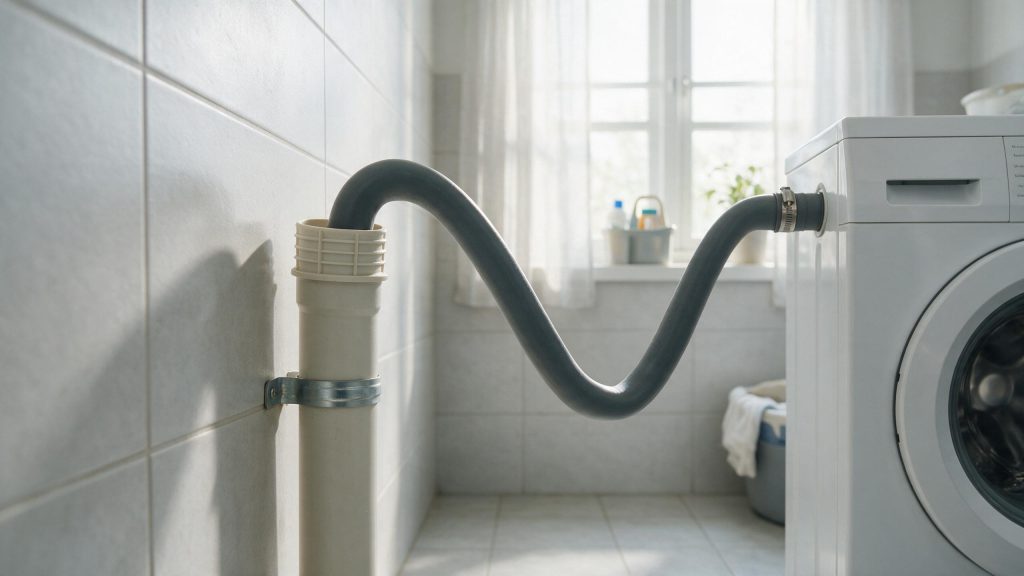

A slow-draining Electrolux washer most often comes down to the path after the pump: a kinked drain hose, a standpipe that is too tall or sealed too tightly, or a restricted house drain. Check those before assuming a washer fault. If the hose and standpipe are right and the washer still holds water, stop running cycles and book service.
Electrolux Washer Draining Slowly
When your Electrolux washer takes much longer than normal to remove water, the machine may pause before spin, leave laundry wetter than expected, or eventually show a drain-related message. The first place to look is not inside the cabinet. It is the route the water must travel after the pump sends it out of the washer.
A slow-drain symptom is especially useful because you can compare it with what happens at the standpipe. If the washer pumps strongly but the standpipe backs up, the home drain is the likely bottleneck. If the hose is clear and the household drain accepts water normally, the washer itself moves higher on the diagnostic list.
Follow the Drain Hose From Washer to Standpipe
Look along the accessible drain hose and make sure it is not sharply bent, pinched behind the machine, crushed by the wall, or trapped under another object. A hose can appear connected correctly while still having enough restriction to slow water flow.
| Symptom | What it can point to | What you can check |
|---|---|---|
| Water drains slowly and the standpipe backs up | Restricted house drain pipes | Stop testing and have the home drain checked |
| Pump runs strongly but drain is slow | Kinked or crushed hose, or hose placed outside requirements | Straighten the hose and review the installation instructions |
| Pump only hums and water stays | Obstructed pump or washer drain path | Stop and book diagnosis |
Do not pull the washer forward aggressively if doing so could damage water lines, flooring, or the power cord. If the hose cannot be inspected safely, leave that part for service.
Watch What the Standpipe Does During Drain
A household drain restriction can imitate a washer problem. During a drain portion of the cycle, observe the standpipe area from a safe distance. Water should enter the drain without rising toward the top or spilling out.
If the standpipe backs up, stop testing the washer. The home drain needs attention before further appliance diagnosis makes sense. Running repeated drain cycles into a restricted standpipe only increases the chance of water damage.
Check Hose Height and Air Around the Standpipe
Drain-hose installation affects how the washer empties. Electrolux support notes that standpipe height and hose placement matter, and the hose should not be sealed airtight into the standpipe.
An airtight seal can interfere with normal drainage behavior. A hose installed outside the height range specified for the model can also create pump-out problems. Use the installation instructions for your exact washer rather than copying dimensions from another model. The use-and-care manual for Electrolux front-load washers lists a standpipe taller than 8 ft among the causes of slow or no drain.
Why Slow Draining Can Affect the Spin Cycle
The washer needs to remove enough water before it can move into normal high-speed spin. If water remains in the drum, the control may extend the cycle, pause, or limit spin.
That is why “clothes are still soaked” and “washer drains slowly” often belong to the same diagnostic path. Correcting the drain restriction can sometimes restore both normal cycle time and normal final spin without any other change.
One Useful Retest After an External Correction
If you found a kinked hose or corrected a clear installation issue, run one drain/spin test with the washer mostly empty. Listen for steady pump operation and watch the household drain.
Do not keep repeating the test if the pump only hums, the standpipe overflows, or the washer still cannot remove water. At that point, more cycling does not add useful information.
Common Questions About Slow Draining
What drain problems does the manual list?
The manual lists a kinked or clogged drain hose, a standpipe taller than 8 ft and clogged house drain pipes as causes of slow or no drain.
Why is my laundry soaking wet after the cycle?
Overloading, a load that is too small, an unbalanced load or a kinked drain hose are all listed as causes of a wet load after spin.
What Can Cause Slow Draining?
Common possibilities include:
- A kinked or crushed drain hose.
- A restricted household drain or standpipe.
- Drain-hose placement outside the installation requirements.
- A partial restriction in the washer drain path.
- A weak or obstructed drain pump.
- A pressure-sensing or electronic control issue.
- Electrolux Washer Repair
- Electrolux Washer Error Codes
- Electrolux Washer Not Starting: What to Check Before Repair
- Electrolux Front Load Washer Leaking Water: Safe Checks by Leak Location
- Electrolux Washer Not Starting: What to Check Before Repair
- Electrolux Washer Leak Repair Cost: Hose, Door, Drain, or Internal?
- Electrolux Washer Is Loud or Vibrating: When the Movement Becomes a Safety Risk
These causes are not interchangeable. A plumber may be the right next step for a backing-up standpipe, while a washer technician is appropriate when the household drain is clear but the washer still pumps out slowly.
Use a Repeatable Troubleshooting Sequence
Change one condition at a time and record the result. Confirm the operating mode or setting, compare a related function that still works normally, perform one safe external check, and then reassess.
If the same symptom remains, do not keep adding resets or random parts. Record the complete model number and any displayed code before power is interrupted. That gives a technician a cleaner starting point.
When to Stop Troubleshooting
Stop using the washer if water backs up from the standpipe, leaks onto the floor, or the pump produces an abnormal hum without moving water. Also stop if the same slow-drain behavior returns immediately after you have confirmed that the visible hose and household drain are clear.
When to Book Electrolux Washer Repair
If the external drain route checks out but the machine still takes too long to pump out, book washer repair. Share whether water remains in the drum, whether the pump can be heard, whether the standpipe accepts water normally, and whether final spin is also affected.
A technician can then focus on the pump, internal drain path, pressure system, wiring, and control logic instead of starting from a generic “washer not working” description.
FAQ
Can a kinked drain hose slow an Electrolux washer?
Yes. Electrolux specifically recommends checking for a kinked drain hose when the washer drains slowly.
Why should the drain hose not be sealed tightly into the standpipe?
The standpipe needs normal air movement around the drain hose. A completely airtight installation can contribute to improper drain behavior.
Can slow draining leave clothes wetter after the cycle?
Yes. The washer may delay or limit high-speed spin when it has not removed water as expected.
What if the standpipe overflows only when the washer drains?
That strongly suggests the household drain cannot accept the washer’s discharge rate. Stop washer testing and address the drain before assuming the appliance pump is the cause.
Related Electrolux Repair Resources
Similar Articles
Keep reading
Similar articles
Electrolux Microwave Vent Fan Keeps Running: A Step-by-Step Heat and Control Check
A vent fan that keeps running on an Electrolux over-the-range microwave is often the microwave protecting itself from heat that rises off the cooktop…
Electrolux Dryer Takes Too Long to Dry: A Step-by-Step Airflow Check
When an Electrolux dryer takes too long to dry, the cause is nearly always that damp air cannot leave the drum fast enough: a…
Electrolux Dishwasher Not Draining: A Step-by-Step Drain-Path Check
When water stays in the tub, work along the drain path: confirm the cycle actually finished, clean the filters, check the drain hose for…
Book a repair
Tell us what’s wrong — we’ll take it from there
Share a few details and we’ll confirm an appointment. Prefer to talk? Call us and we’ll help right away.
Address
We operate in California, Florida, New York, and Texas.
Phone
(844) 917-2115
Hours
Mon–Fri 8:00 AM – 6:00 PM · Sat 9:00 AM – 2:00 PM
Service area
We currently serve the Miami, New York, Houston, Los Angeles and San Diego metro areas, including many surrounding communities.
Response time
Same-day and next-day appointments are often available — confirm with your ZIP code.
Directions
View on map
Request your repair
Fields marked with * are required.